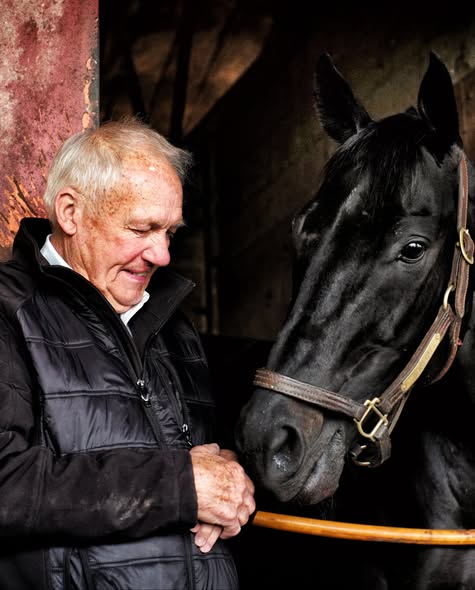
King Leatherbury, a towering figure in North American horse racing whose career spanned more than six decades, is being remembered as one of the most influential and accomplished trainers the sport has ever known. Born March 26, 1933, in Shady Side, Maryland, Leatherbury’s journey into racing began early, shaped by childhood days spent on his family’s farm surrounded by horses.
After graduating from the University of Maryland with a degree in business administration, Leatherbury pursued his passion professionally, obtaining his trainer’s license in 1958. Just a year later, he celebrated his first career victory at Sunshine Park — now known as Tampa Bay Downs — marking the start of a historic run rarely matched in the sport.
Support the Family
In lieu of flowers, your kind contribution will help the family during this difficult time. Every gesture of support brings comfort and shows you care. Your generosity is deeply appreciated.
Donate NowThank you for your support and love during this time.
When Leatherbury retired in 2023, his résumé stood as a testament to consistency and excellence. He recorded 6,508 career wins, placing him among the winningest trainers in North American racing history. His horses earned more than $64 million in purse money, and his dominance in Maryland was unrivaled: 52 training titles overall, split evenly between Pimlico Race Course and Laurel Park, along with four championships at Delaware Park.
Leatherbury was especially renowned for his brilliance in claiming races, where sharp instincts and strategy often separate good trainers from great ones. His success in that arena made him a mentor and blueprint for generations of horsemen. In the late 1970s, he topped all North American trainers in wins in back-to-back years, further cementing his reputation as a master of the craft.
His influence reached far beyond statistics. Alongside Bud Delp, Richard Dutrow Sr., and John Tammaro Jr., Leatherbury formed Maryland racing’s celebrated “Big Four,” a group that helped elevate the region’s prominence during the 1960s and 1970s.
Among the many horses that defined his career, none captured the public’s affection quite like Ben’s Cat. The homebred star won 32 races, earned more than $2.6 million, and collected multiple Maryland-bred Horse of the Year titles, becoming a symbol of Leatherbury’s patient and intuitive training style.
In 2015, Leatherbury received racing’s highest honor with a first-ballot induction into the National Museum of Racing and Hall of Fame, a recognition that affirmed his lasting impact on the sport.
Leatherbury is survived by his wife of 62 years, Linda Marie Heavener Leatherbury, his twin sons Taylor and Todd, and a grandson. Memorial service details have not yet been announced.
King Leatherbury’s legacy is woven into the fabric of American horse racing — a career defined not only by victories, but by mentorship, innovation, and an enduring love for the sport that will resonate for generations to come.